Table of Contents:
Top Picks!
Related Stories





AI Replacing Jobs: The Anxiety of Change vs. The Reality of Data!
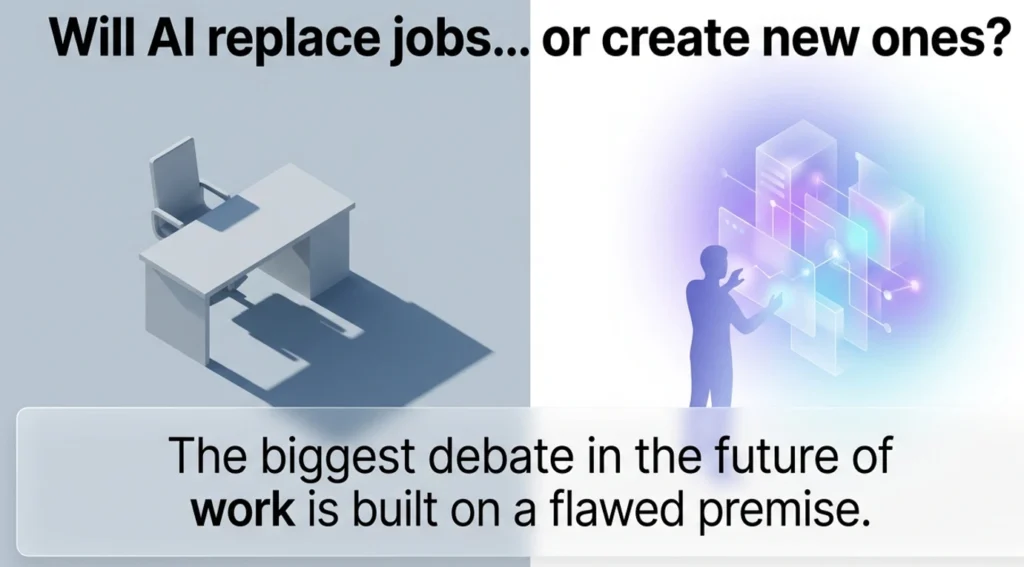
As Generative AI (GenAI) integrates into the global economy, it has sparked a profound “societal angst.” Public discourse often oscillates between dystopian fears of total displacement and utopian promises of an effortless future. However, the latest 2026 findings from the World Economic Forum (WEF), the International Labour Organization (ILO), and LinkedIn offer a far more nuanced roadmap.
This guide moves past the hype to deliver the data-grounded reality of the 2026 job market. We are entering a period of rapid transition, but the “reset” is defined less by the disappearance of work and more by the evolution of roles. For the forward-looking professional, understanding these shifts is no longer optional—it is the prerequisite for career survival in the machine age.
1. The Growth Paradox: Digital Access as the Engine of Opportunity!
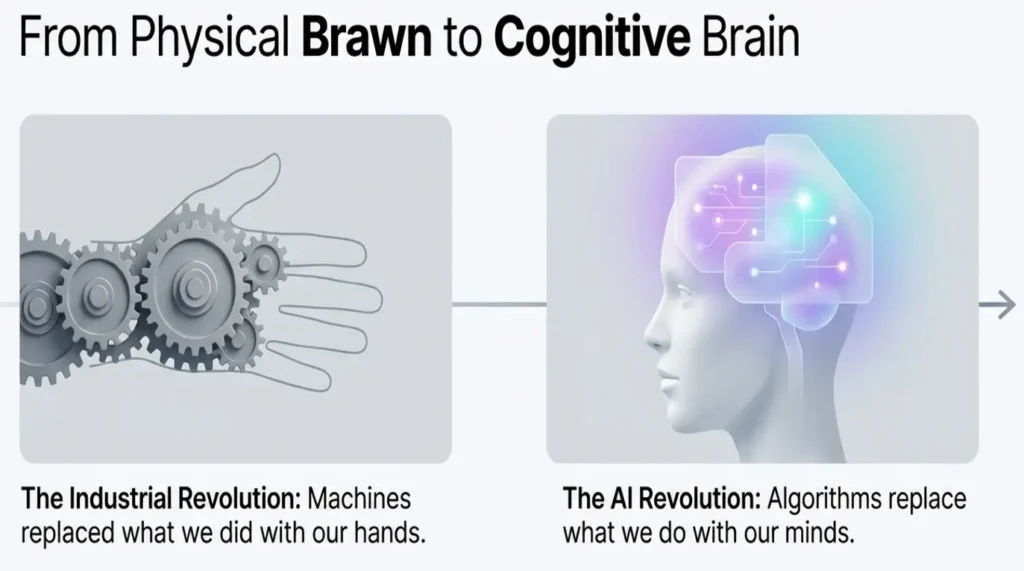
According to the WEF Future of Jobs Report 2026, the most influential macro trend affecting global business is not AI in isolation, but the broadening of digital access. This serves as the underlying engine for all other shifts, enabling the deployment of everything from robotics to green energy storage.
The data reveals a “growth paradox”: while technology is often feared as a displacer, it is currently a massive net job creator. However, we must distinguish between general digital trends and AI specifically:
The Digital Macro-Trend: Broadening digital access is expected to create 19 million jobs globally by 2030, while replacing 9 million.
The AI Specifics: AI and data processing alone are projected to create 11 million roles against 9 million replaced.
The Winners: We are seeing a surge in demand for Big Data specialists, Fintech engineers, AI/ML specialists, and Green Transition specialists (such as environmental and renewable energy engineers).
The scale of this shift is reflected in the boardroom. The WEF found that:
“86% of executives expect AI and information processing technologies to transform their business by 2030.”
2. The Visibility Trap: High-Income Countries and the Clerical Crisis!
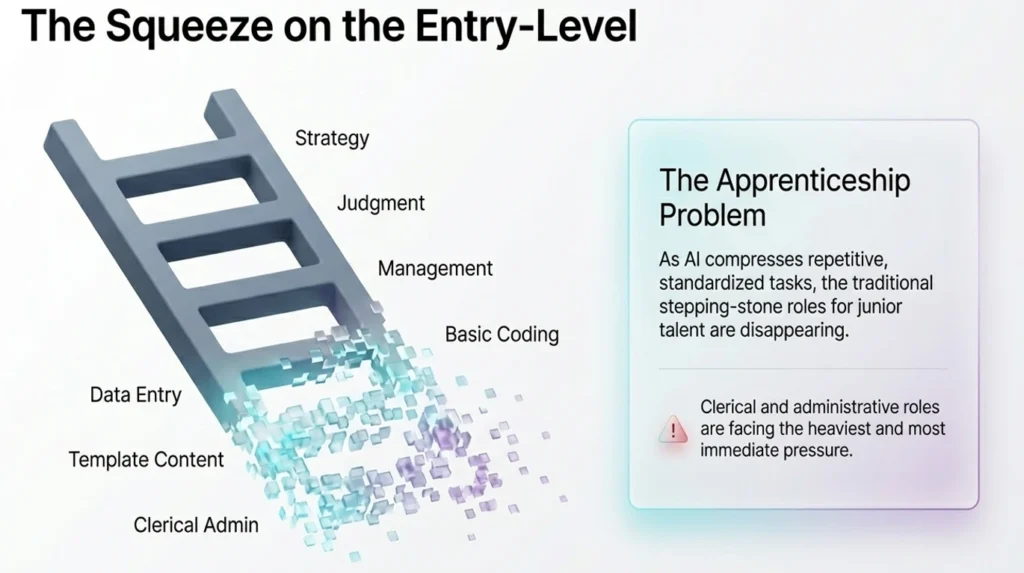
A striking shift in 2026 is the “Geography of Risk.” Previous industrial revolutions targeted manual labor in lower-income manufacturing sectors. GenAI, however, is a “knowledge work” technology, placing the highest burden of exposure on advanced economies.
The Four Gradients of Exposure The ILO’s 2026 revised framework uses four progressively increasing gradients to measure risk. Globally, 25% of workers have some exposure, but the intensity is concentrated:
Gradient 4 (Highest Exposure): This category includes roles where the majority of tasks can be replicated by GenAI. While it represents only 3.3% of global employment, the geographic disparity is stark.
High-Income Countries (HICs): 34% of total employment is exposed to GenAI.
Low-Income Countries (LICs): Only 11% of total employment faces exposure.
The “Clerical Crisis” is the epicenter of this shift. Clerical support workers—including administrative assistants, cashiers, and accountants—face the highest exposure levels. GenAI’s ability to process language and data means white-collar “knowledge work” in Finance, Tech, and Professional Services is now on the frontlines of disruption.
3. The Pink-Collar Frontline: Why the AI Revolution is Not Gender-Neutral!
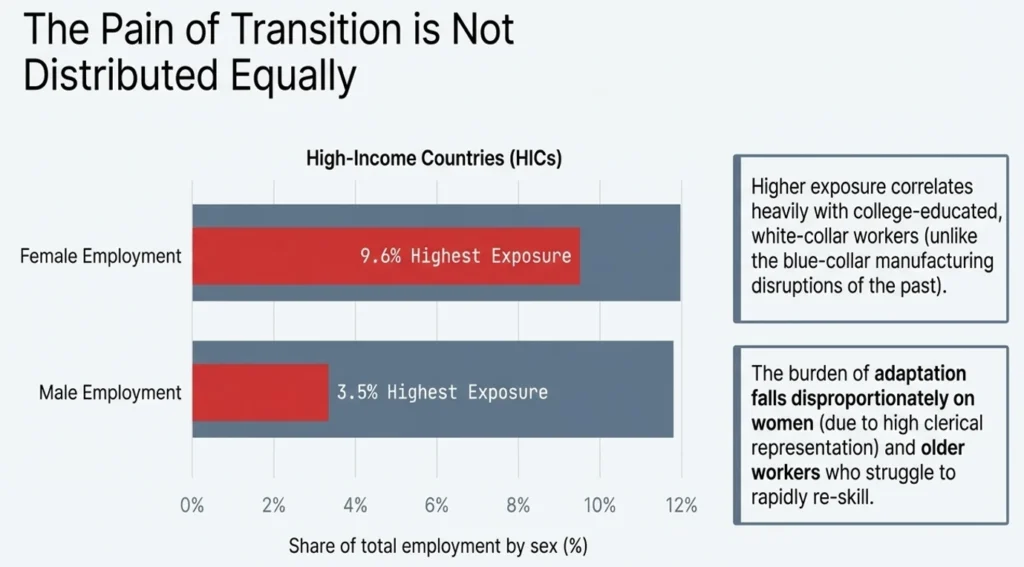
The 2025 reset has a significant gender dimension. Because women are historically overrepresented in the clerical and administrative roles identified in the “Highest Exposure” category (Gradient 4), they face a disproportionate risk of displacement.
Global Disparity: Global employment in the highest exposure category is 4.7% for women versus 2.4% for men.
The HIC Gap: In advanced economies, the risk intensifies. 9.6% of women in HICs are in the highest exposure category, compared to just 3.5% of men.
Impacted Roles: Medical clerks and customer service representatives are among the most vulnerable.
However, exposure does not have to equal unemployment. Strategically, workers can use skills-based pathways to pivot. For example, an Administrative Assistant shares 50% of the same skills with an Event Coordinator—a role that is significantly less exposed to GAI. As LinkedIn notes:
“Women who combine an understanding of AI with their people skills are in a prime position to navigate this disruption.”
4. The 2030 Skill Expiry Date: Agility as the New Currency!
The shelf life of professional skills is shrinking. While the WEF estimates that 39% of workplace skills will change by 2030, LinkedIn projects an even more aggressive 70% shift. This discrepancy likely stems from LinkedIn’s focus on white-collar sectors like Tech and Finance, where GenAI’s impact is most intense.
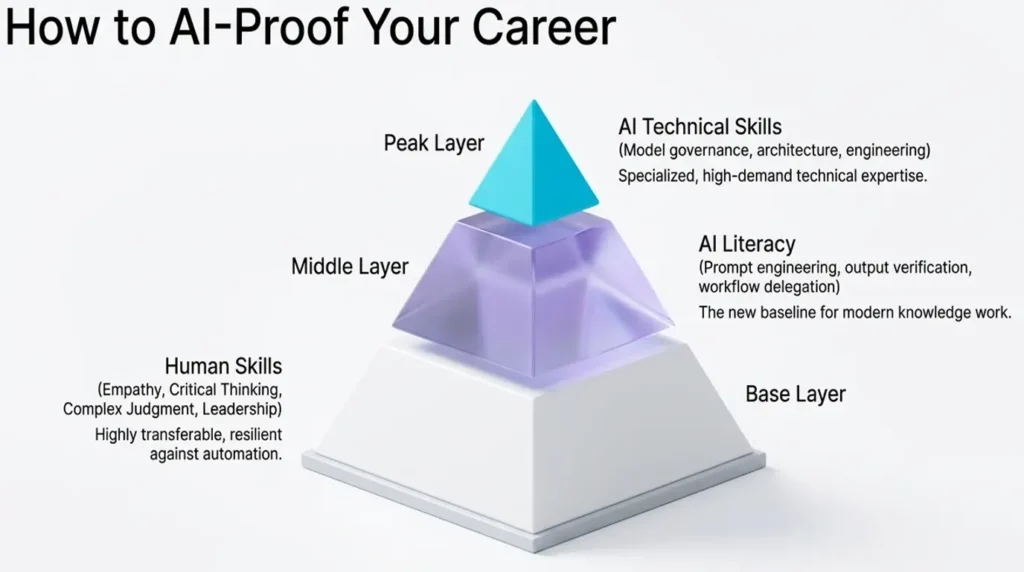
C-suite executives are already shifting their hiring criteria; 38% now prioritize “agility” over specific experience for entry-level roles. This is a tactical response to the fact that GenAI can now replicate traditional junior tasks like basic writing and analytics. To remain competitive, workers must master the “New Skill Trio”:
AI Technical Skills: Expertise to design and maintain AI systems. Hiring for “AI Engineer”—the fastest-growing job title last year—has quadrupled since 2016.
AI Literacy: The “bridge” skill. It is the ability to effectively interact with tools like ChatGPT. 66% of leaders say they would not hire a candidate who lacks this literacy.
Essential People Skills: As machines handle operations, “human” skills like leadership, conflict mitigation, and stakeholder management are becoming more valuable. In the US, eight of the top ten fastest-growing skills are now people-centric.
5. From Executor to Editor: Navigating the $6.6 Trillion Transformation!
The core argument of the ILO and LinkedIn research is that Transformation is more likely than Substitution. Because most occupations are a “bundle of tasks,” the human role is shifting from “executor” to “editor and strategist.”
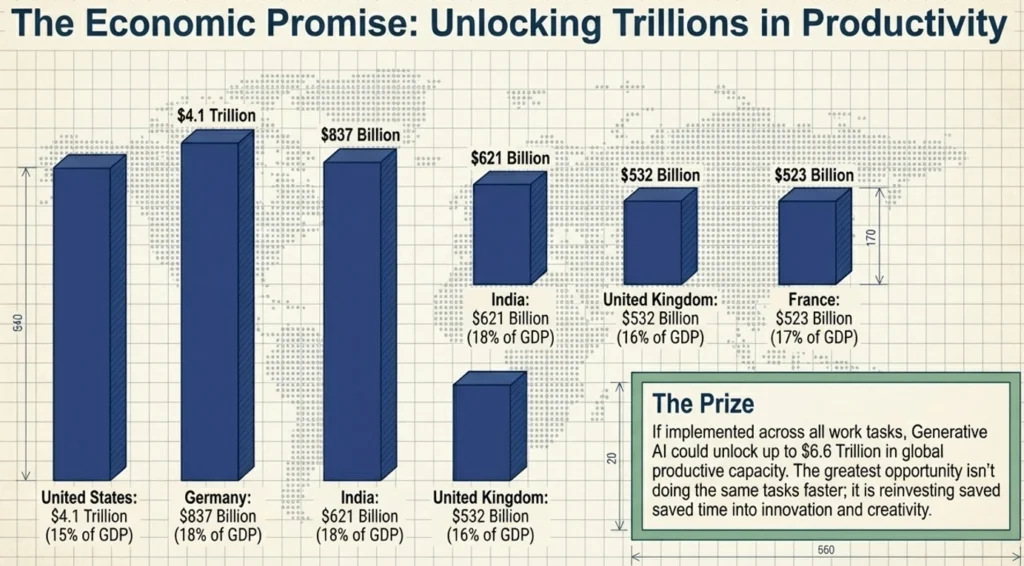
The Trillion-Dollar Potential If GenAI is implemented across all work tasks, it could unlock $6.6 trillion in productive capacity across major economies. However, this potential is currently concentrated:
The US Dominance: The United States accounts for $4.1 trillion (62%) of that global potential.
The SMB Barrier: A significant hurdle is the adoption lag in Small and Medium Businesses (SMBs). Only 41% of SMBs leverage GenAI, compared to 48% of large corporations.
The “Why”: SMBs are held back by cost and lack of resources. Closing this gap requires targeted policy responses, such as government grants and subsidies to ensure the $6.6 trillion gain isn’t restricted to corporate giants.
The ILO’s 2026 conclusion remains the definitive word:
“Transformation of jobs is the most likely impact of GenAI.”
Conclusion: The Final Thought-Provoking Question!
The 2026 Job Reset is not a single event but a rapid evolution. While the transition poses risks—particularly for women in high-income countries—the data suggests a net expansion of opportunity. The difference between those who are displaced and those who thrive will depend on “social dialogue,” targeted policy, and individual adaptability.
A Final Ponderable: If 70% of your professional toolkit is expected to be different by 2030, what are you learning today to ensure you are the one driving the machine, rather than being managed by it?