Table of Contents:
Top Picks!
Related Stories





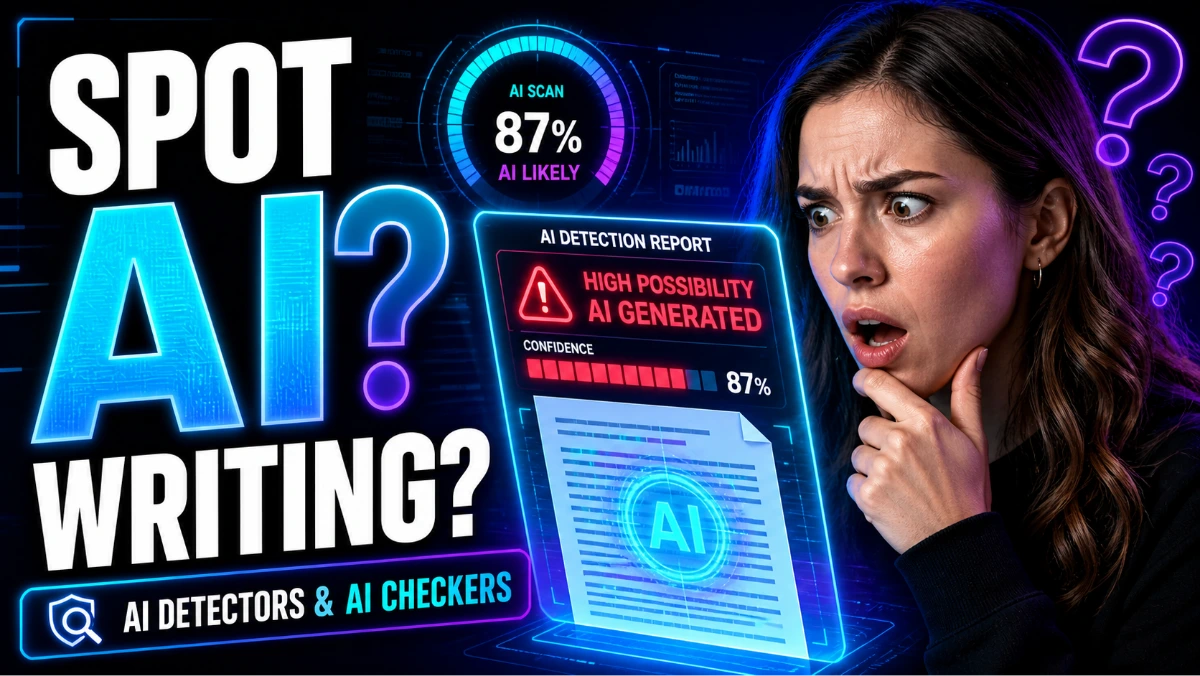
In less than three years, the landscape of written communication has shifted fundamentally. The sudden, overwhelming ubiquity of generative AI has turned every student essay and editorial submission into a potential site of skepticism. For educators and editors, this has fostered a profound “anxiety of authorship.” When a paragraph flows with perfect cadence, is it the result of a human’s late-night breakthrough or a large language model’s (LLM) statistical prediction?
We find ourselves in a new frontier where trust is the primary currency, but we lack a foolproof way to verify it. As we scramble for tools to tell us what is “real,” we must confront a difficult truth: current detection methods are far more complex—and deeply flawed—than the marketing suggests.
As a researcher in digital ethics, I believe we must start with a foundational premise: AI detection is a game of probability, not a binary proof. The quest for a “perfect” detector is not just difficult; it is a moving target that may be scientifically out of reach.
The “Non-Native” Penalty and the Perplexity Paradox!
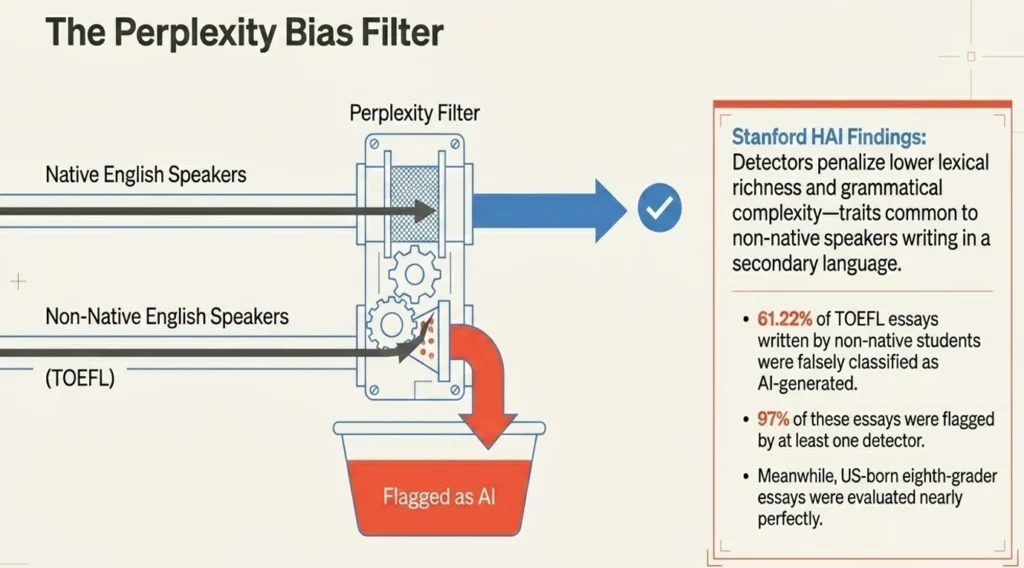
One of the most significant ethical hurdles in AI detection is the reliance on “perplexity.” In the world of Natural Language Processing, perplexity measures how predictable a text is. AI models are trained to be statistically probable; therefore, text with low perplexity is frequently flagged as AI-generated.
However, research from Stanford HAI reveals a disturbing bias: this metric disproportionately penalizes non-native English speakers. In a landmark study, researchers found that while detectors were nearly perfect at identifying essays by U.S.-born eighth-graders, they misclassified over 61.22% of TOEFL (Test of English as a Foreign Language) essays as AI-generated. Even more startling, 97% of those human-written essays were flagged by at least one detector.
The reason is technical: non-native speakers often trail native counterparts in “lexical richness, syntactic complexity, and grammatical complexity.” By writing in a style that is “simple and correct,” these authors inadvertently mirror the low-perplexity signature of a machine.
“It comes down to how detectors detect AI. They typically score based on a metric known as ‘perplexity,’ which correlates with the sophistication of the writing — something in which non-native speakers are naturally going to trail their U.S.-born counterparts.” — James Zou, Stanford University Professor
The 20% “Dead Zone” in Detection Accuracy!
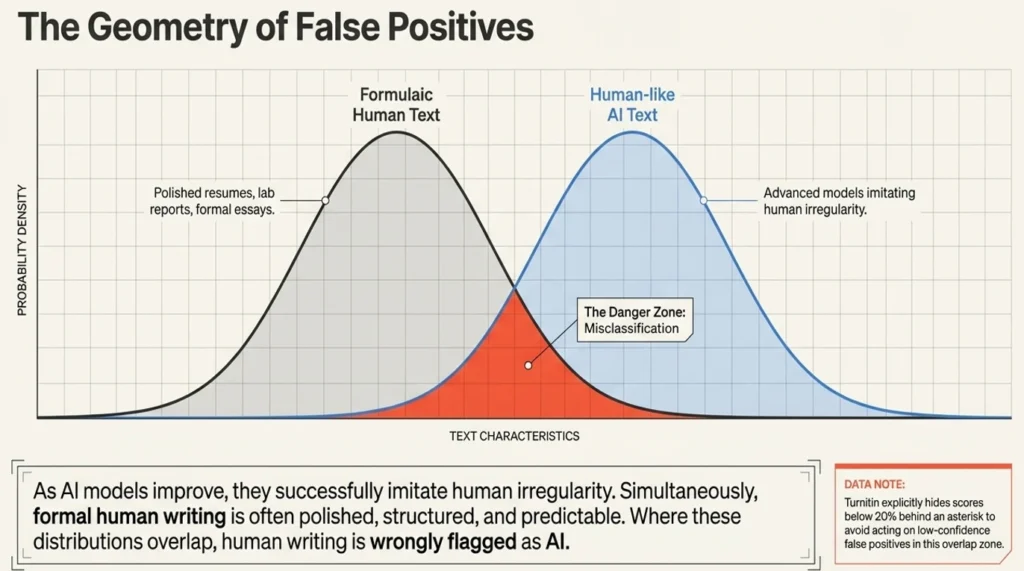
The industry’s leading tools are beginning to acknowledge these limitations by introducing thresholds of uncertainty. As of July 2024, Turnitin made the strategic decision to stop surfacing specific percentage scores that fall below 20%.
The Threshold of Uncertainty The statistical reasoning is clear: the incidence of false positives—human writing incorrectly flagged as machine-made—is significantly higher in the 1% to 19% range. To mitigate the risk of unfair accusations, Turnitin now indicates scores in this range with an asterisk (*%) rather than a numerical value.
While a “1% false positive rate” sounds negligible in a laboratory, it is a massive liability at scale. If a university screens 100,000 human-written papers, a 1% error rate results in 1,000 students being potentially accused of misconduct. This shift from a number to an asterisk is a vital signal to educators that low-level scores are a prompt for caution, not a verdict of guilt.
The Evasion Arms Race: By passers and Spoofing!
As detection models improve, so do the tools designed to break them. This “cat and mouse” game has led to a sophisticated arms race. Turnitin’s current interface now attempts to categorize this tension using specific interactive highlights: Cyan for “AI-generated only” and Purple for “AI-generated text that was AI-paraphrased” (using tools like Quillbot).
Research by Sadasivan et al. highlights the effectiveness of “recursive paraphrasing,” where text is repeatedly scrubbed of its original statistical signature. However, the study also warns of a darker ethical vulnerability: spoofing attacks. In these cases, an attacker could intentionally modify human-written text to trigger an AI watermark signature, weaponizing the detector to damage a writer’s reputation.
Detection currently fails across three core fronts:
Recursive Paraphrasing: Using secondary AI to rewrite content until the signature is lost.
Adversarial Editing: Humans adding intentional “burstiness” or structural irregularities to confuse classifiers.
Spoofing and Hybridization: Intentionally mimicking AI patterns or blending human drafting with AI grammar support, creating a signature that fits neither category.
The Hidden Signature: Watermarking vs. Guesswork
Traditional “post hoc” detectors are essentially guessing based on style. A more robust—though not universal—alternative is generative watermarking, such as Google DeepMind’s SynthID-Text.
Unlike style-based detection, SynthID-Text uses a method called Tournament Sampling. This modifies the sampling procedure during the generation process itself, embedding a hidden statistical signature without degrading text quality. It is “production-ready” because it is computationally efficient and does not require access to the underlying LLM for detection.
“SynthID-Text is a production-ready text watermarking scheme that preserves text quality and enables high detection accuracy… It modifies only the sampling procedure; watermark detection is computationally efficient, without using the underlying LLM.” — Nature, 2024
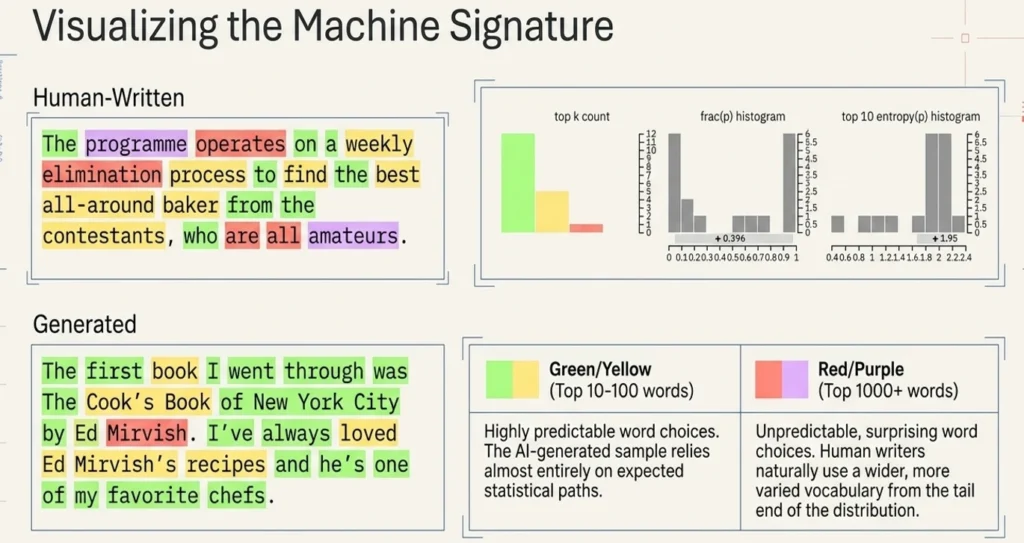
For those seeking to build AI literacy, visualization tools like the Giant Language Model Test Room (GLTR) offer a way to “see” the machine. GLTR highlights tokens based on their predictability—Green for the top 10 most likely words, Yellow for the top 100, and Red/Purple for outliers. When a document is a sea of Green and Yellow, it reveals the statistical predictability that defines machine-generated prose.
Detection is a Signal, not a Verdict!
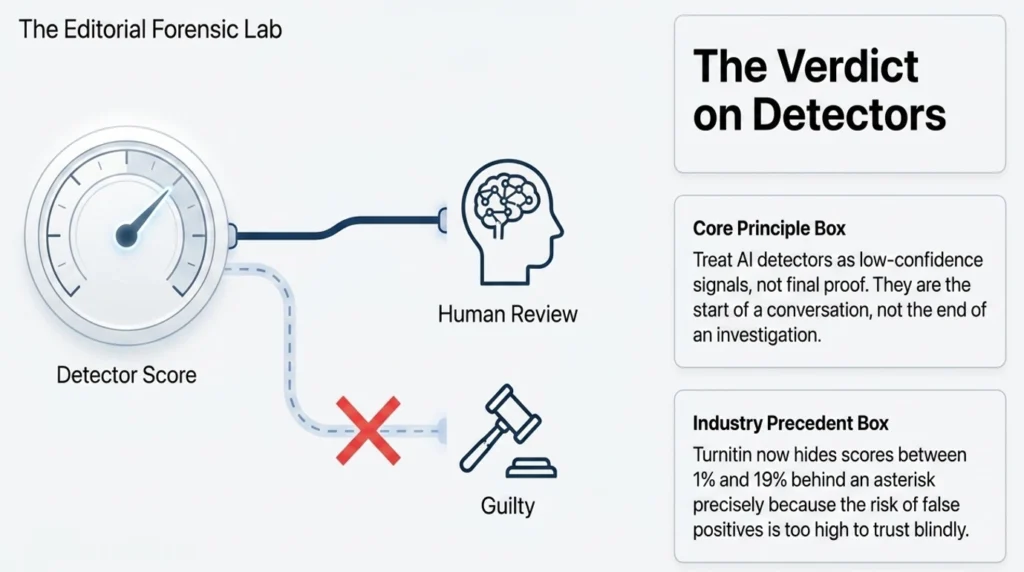
The ultimate takeaway from current research is that a detector score should never be the final word. Because detectors estimate probability rather than observing the writing process, we must move toward a “Review Ladder” approach.
The specific sequence for a responsible inquiry should be:
Detector Signal: Note the score as a prompt for inquiry.
Human Review: Analyze the text for nuances, such as consistent voice or “hallucinated” citations.
Author Conversation: Open a dialogue with the writer about their process.
Evidence Check: Review process-related artifacts (drafts, notes, or version history).
Final Decision: Reach a verdict based on the totality of evidence.
Responsible Use Checklist
Establish Disclosure Policies: Define what AI assistance (e.g., brainstorming vs. drafting) is acceptable.
Request Process Evidence: Encourage the use of platforms that track version history (like Google Docs) to verify the human creative journey.
Contextualize the Score: Be extra cautious with technical reports, formulaic assignments, or writing from non-native speakers.
Acknowledge Uncertainty: Use the score as a reason to start a conversation, never as the sole basis for disciplinary action.
Conclusion: Beyond the Red and Green Highlights!
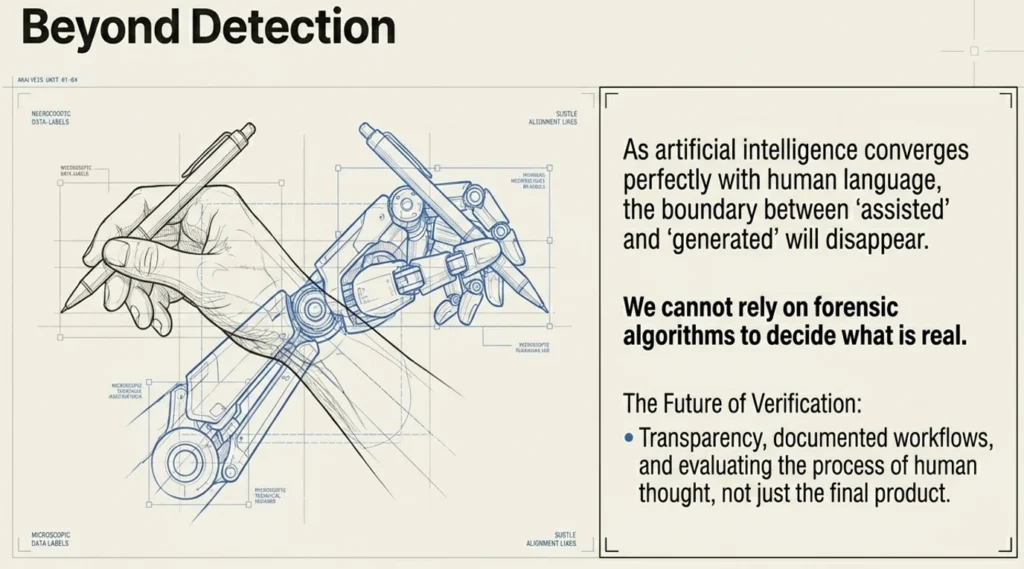
We are moving past the era of simple “Red” (AI) and “Green” (Human) highlights toward a model of “layered transparency.” This involves aligning with the NIST AI Risk Management Framework (AI RMF 1.0) and its Generative AI Profile to manage the inherent risks of these models.
Furthermore, the emergence of C2PA Content Credentials offers a path toward true provenance. Unlike style-based guessing, C2PA provides a “cryptographically signed, tamper-evident” record of a file’s origin and editing history.
The deeper question for our era remains: In a world of seamless human-AI collaboration, should our goal be to “catch” the machine, or to redefine what “original work” means? Perhaps the future of integrity lies not in policing the final output, but in valuing the transparency of the human process.